Course Information
Introduction to Intelligent Systems - Fall 2020
Instructor: Prof. Songhwai Oh (오성회) Email: songhwai (at) snu.ac.kr Office Hours: Friday 2:00-4:00PM Office: Building 133 Room 405 | Course Number: 430.457 Time: MW 11:00-12:15 PM Location: Online (Building 301 Room 103) |
TA-1: Jeongho Park (박정호) TA-3: Wooseok Oh (오우석) | TA-2: Hogun Kee (기호건) TA-4: Jae Eun Kim (김재은) |
Course Description
This course introduces the foundations of intelligent systems, such as probabilistic modeling and inference, statistical machine learning, computer vision, and robotics, to undergraduate students. Topics include Bayesian networks, hidden Markov models, Kalman filters, Markov decision processes, linear regression, linear classification, neural networks, deep learning, nonparametric models, and reinforcement learning. Students will also learn about how these methods are applied to practical applications such as computer vision and robotics. Lectures will be in English.
RC Car Racing: A Navigation Challenge
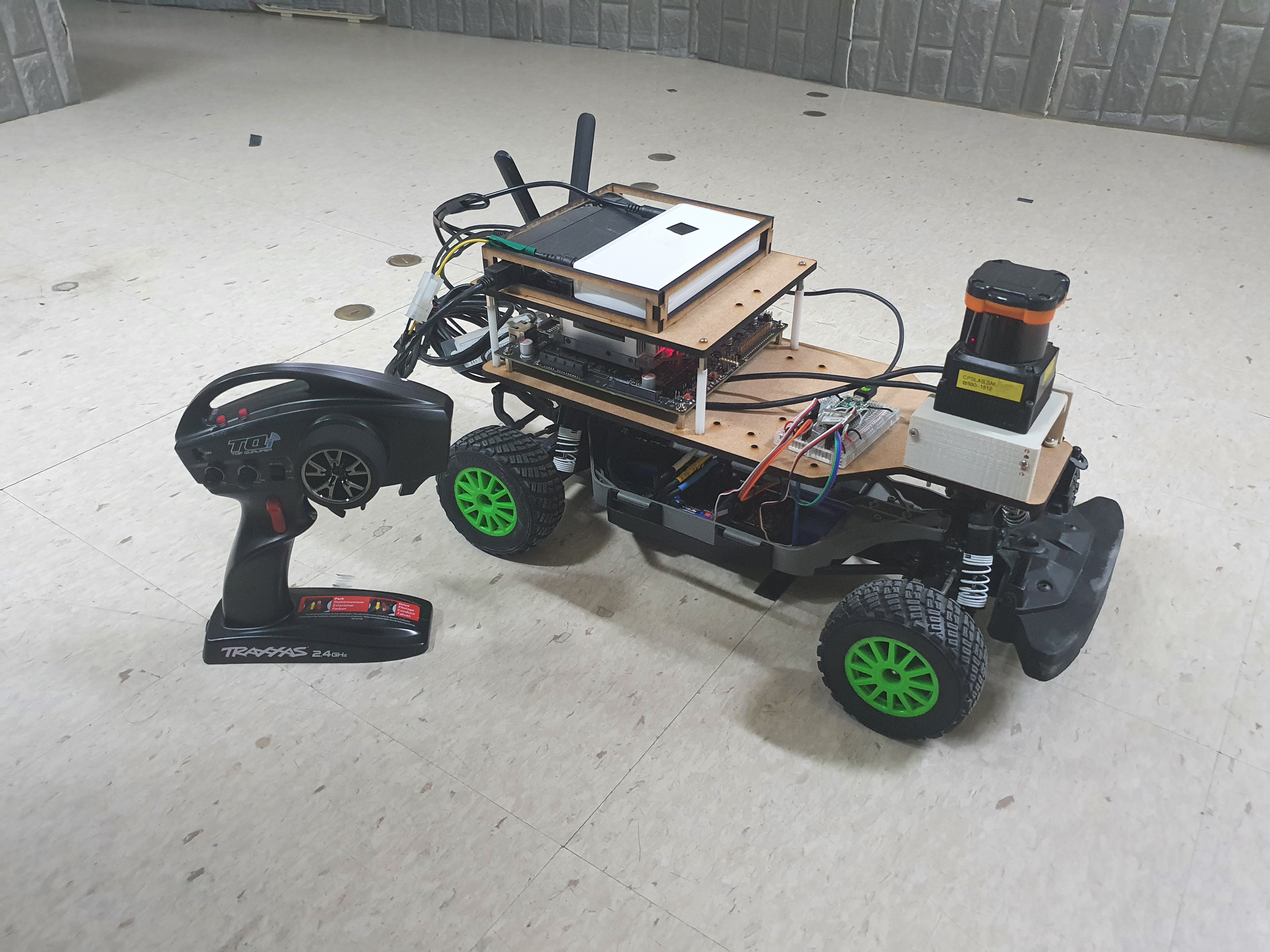
- More information about autonomous robot navigation challenge
- More videos and photos from the navigation challenge
Project and Announcements
- Project Information
- [12/10] Hardware setup (12/14-12/17)
- [12/09] Final Project (due: 12/13, 23:59 KST)
- [11/24] Project 4 (due: 12/04, 23:59 KST)
- [11/11] Project 3 (due: 11/23, 23:59 KST)
- [10/28] Project 2 (due: 11/11, 23:59 KST)
- [10/13] The midterm will be held in class on 10/21 (Wed). The exam is closed-book but you can bring one sheet (A4) of hand written notes on a single side (the other side must be blank). You have to turn in this cheat sheet with your exam.
- [09/28] Project 1 (due: 10/14, 23:59 KST)
- [09/16] Preliminary Project 2 (due: 9/28, 23:59 KST)
- [09/02] Preliminary Project 1 (due: 9/16, 23:59 KST)
- [08/28] Please read the Ethics of Learning.
Schedule
Week | Reading | Date | Lecture | Date | Lecture |
|---|---|---|---|---|---|
1 | 9/2 |
| 9/4 |
| |
2 | AIMA Ch. 13, Ch. 14.1 - 14.3 | 9/7 |
| 9/9 |
|
3 | AIMA Ch. 14.4 - 14.5 | 9/14 |
| 9/16 |
|
4 | AIMA Ch. 15.1 - 15.3 | 9/21 |
| 9/23 |
|
5 | AIMA Ch. 15.3 - 15.6 | 9/28 |
| 9/30 |
|
| |||||
6 | AIMA Ch. 18.1 - 18.3, 18.4 | 10/5 |
| 10/7 |
|
7 | AIMA Ch. 18.6 | 10/12 |
| 10/14 |
|
8 | AIMA Ch. 18.7 | 10/19 |
| 10/21 |
|
9 | 10/26 |
| 10/28 |
| |
10 | AIMA Ch. 18.8 - 18.9 | 11/2 |
| 11/4 |
|
11 | AIMA Ch. 20.1 - 20.3 | 11/9 |
| 11/11 |
|
12 | AIMA Ch. 16 | 11/16 |
| 11/18 |
|
13 | AIMA Ch. 17.1 - 17.4, Ch. 21 | 11/23 |
| 11/25 |
|
14 | AIMA Ch. 25 | 11/30 |
| 12/2 |
|
15 | AIMA Ch. 25 | 12/7 |
| 12/9 |
|
16 | AIMA Ch. 24 | 12/14 |
| 12/16 |
|
12/19 |
|
Textbook
- [Required] Stuart Russell and Peter Norvig. Artificial Intelligence: A Modern Approach (3rd edition), Prentice Hall, 2009. (AIMA Website)
Topics
- Review of probability and linear algebra
- Probabilistic Modeling and Inference:
- Bayesian networks, Hidden Markov models, Kalman filters
- Markov decision processes
- Machine Learning:
- Linear classification, Linear regression, Learning with complete data
- Deep learning
- Learning with hidden variables, EM algorithm
- Nonparametric models, Support vector machines
- Reinforcement learning
- Robotics:
- Localization and mapping, Motion planning, Planning uncertain movements, Moving
- Robotic software architectures, Application domain
Computer Vision:
- Image formation, Edge detection, Texture, Optical flow, Image segmentation
- Object recognition, Reconstructing the 3D world